Sunday, August 11, 2013

GIve Me Things That Don't Get Lost

Well well dear readers, much has passed since my last post. I’ll begin with a roundabout explanation of the title I’ve chosen for this entry:

This past Friday a few of our team met with the director of the Musanze district branch of EWSA -pronounced ooh-wah-saw for reasons unknown- Rwanda’s federal energy, water, & sanitation authority. Though EWSA did allow us to view some revealing documentation illustrating the existing water infrastructure, the director himself proved about as helpful as Aquaman’s superhuman ability to commune with marine life in any typical human situation (not very). After hearing our aim of extending the existing pipeline to bring water to underserved residents of Cyanika, the director suggested EWSA, rather than EWB, preform the assessment and design the system. Of course he was happy to permit EWB to oversee the implementation and provide all of the funding. Clearly this is not how EWB functions and in no way accords with the tested principles of sustainable community development. Furthermore, EWSA, not Cyanika, would be the eventual owners of the infrastructure and though the director agreed to guarantee Cyanika residents long-term access to the water provided, he was careful not to go so far as to promise ownership of the water rights. Following a good deal of deliberation we were able to convince the director to concede responsibility for designing the system to EWB, so long as the design passed EWSA’s approval prior to implementation, and to support integrating community labor. However, he remained hesitant to relinquish the assessment and refused to budge on the issue of ownership.

Here is where the title comes in- based on the ultimatums proposed in the meeting with EWSA, our team was forced to make a preliminary decision as to whether pursuing an extension of the pipeline in partnership with the government is indeed in the best interest of the community, or if another solution might prove more prudent. The primary alternative under consideration is a series of communal rainwater catchment facilities that would also provide sheltered community-gathering spaces and foundations for future tap stands. Our team recognizes the view prevalent among Cyanika residents of the pipeline as a shiny symbol of modernity; nonetheless catchment offers some undeniably significant benefits. Firstly, like a pipeline catchment would dramatically reduce the need of community members to travel hours a day to gather water for at least 9 months of the year, thereby freeing that time up for other productive activities, and effective sterilization consisting of first-pass sedimentation and chlorination is simple and inexpensive. Secondly, the maintenance of prefabricated plastic tanks is very easy and cheap, and could be more than paid for by the fees charged for access to the water, even if this price were markedly less than what the citizens currently pay. Additionally, the surplus funds could be redistributed within the community either to bankroll further development projects or as stipends to purchase water during the 3-month dry season. Thirdly, conservation practices required for the successful use of rainwater catchment would serve as an ideal vehicle for water and sanitation education based on a curriculum developed and executed by EWB. Lastly, even if EWSA does eventually deliver the pipeline, in the case of potential water shortages or diversions Cyanika would remain in ownership of a sustainable, naturally renewing source of clean water as well as an economic engine. Therefore our team’s decision as of the current moment: Give me things that don’t get lost.

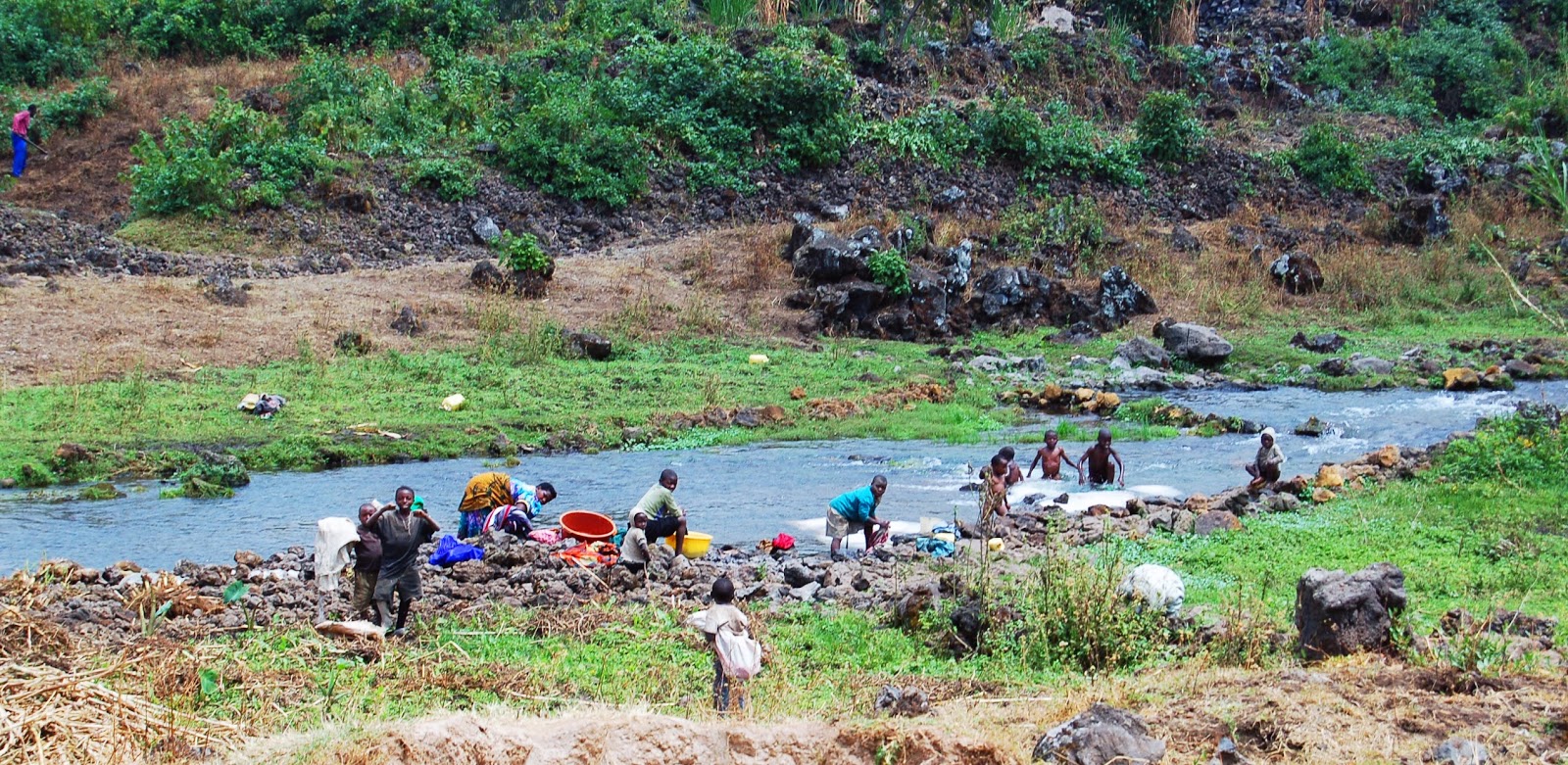
On a lighter note, the team spent the afternoon packing into Cyanika’s executive secretary’s car like so many clowns to visit the Mutobo Water Treatment Plant, a veritable arcadia of kaleidoscopic gardens, chattering brooks, and bathing African cherubs screaming ABAZUNGU! (Kinyarwanda for white people). Somehow, even the dung-dropping cows seemed perfectly picturesque. The sources for this plant are two springs, which percolate upward through volcanic pebbles and are protected by half-acre plantings of chromatic water lilies that towered over all of our heads (except perhaps the executive secretary who happens to be nearly 7 feet tall). The plant employs air stripping, aeration, and chlorination to produce water which our own tests have verified has no harmful bacterium, near 0 turbidity, and a pH safe to drink yet basic enough to kill cancer. Ponce de León would be proud.


Hoping you all find your own fountains of youth,
Michael Salka


Thursday, August 8, 2013

Surveys, Camp Cyanika, and Hoes

Wednesday and Thursday were all about data collection, community interaction, and digging…all under the watchful supervision of all of the children in Cyanika.  There is very little that happens without a curious onlooking from the beautiful and playful children of the community.  The term abazungu (white person) has subsided greatly and they moved on to a more blunt “give me money” or “give me book” spoken in clear English. Once that grew old they were left staring curiously at what these crazy American engineers were doing.  They now feel more comfortable to play games with us, ask our names, and even laugh at/with us.  All of this is part of the bonding process that will hopefully lead to our success with our future project.

We started Wednesday with Ariana, Michael (the one with an S), and me doing surveys of the two the communities.  The surveys were conducted at the cell house (much like a community center) in groups of roughly 15 households.  It was a written, multiple choice survey and we were impressed and the high literacy rate of the community.  They arrived on time and took the survey very seriously.  We unfortunately embarrassed them with a questing regarding how often they cleaned their jerry cans.  The “daily” option was met with “how can we clean it daily if we cannot get water daily?”  This is definitely a first world oversight on our part.  Aside from that small blunder it was a good way to interact with and receive information from the community. 


While this was happening Michael (the one with an S), Jordan, and Stephanie went to measure a roof for Carole’s work back in the States. Along the way the group learned the following important lessons: 1) “they all came from God” 2) they all need to learn swahili and 3) a tape measurer is by far the most interesting thing that the people in the village had seen in a long time.   All are equally important lessons.  The roof measurements show that one of the sides of the building is 1 foot higher than the other side.  This fact will prove important if we should consider rainwater catchment systems in the future.

In the afternoon we continued walking to understand the layout of existing pipes.  We keep coming back to a tank that seems to have a mystery surrounding it.  The pipe goes from a low elevation at the road up to a higher elevation tank and back to the road?  This is not to build head/pressure, they tell us.  We also felt the pipe moving below the ground with such vigor that it made us repeatedly question if there was a pump.  After much debate about the reason for this pipe to the tank we learned that the Chinese built the pipe in the road and EWSA (local water governance) was building a tank, which the Chinese asked to utilize for water storage.  This new fact didn’t really help solve any mystery but instead just peeled back one more layer of the onion. 

So after trying to wrap our brains around the Rwandan-Chinese spaghetti system of water piping we retired back to the monastery.  Not without first stopping in town at the “hardware store” (read as: American gents go to your local home depot and kiss the ground) to buy PVC glue…more to follow later on PVC glue adventures….no moms, sniffing was not included.

The evening consisted of sleeping, eating, working, sleeping…no card games, no riddles, I want my money back for Wednesday evening. (says the mentor)

Oooh speaking of mentor I think I should advise you of a few lessons I have learned myself. I am trying to learn Kinyarwandan.  So far I’ve learned the word for let’s go, goodbye, cow, and nanny (couldn’t find anything similar to mentor…that will have to do).  My “lessons I’ve learned” have nothing to do with my learning, but moreso an observation that when they say it gets harder to learn a language as you get older, it is true.  I am SO impressed that the students are learning things like numbers, “how are you”, “what is your name,” etc.  They are very impressive!  I will never understand how to say the number six (GahTahnDahToo) and so I stopped worrying about numbers…I have fingers. Cows on the other hand are used in so many sentences in my day to day language that I knew I must learn the word.

Is it Thursday already?  Why yes it is and today we are going to….?  Yes, you guessed it.  Today included walking, camp Cyanika, and hoes. Today was the end of Ramadan and the entire country had a holiday. This meant that some of what we wanted to do was put to the wayside this morning, which allowed us to have some fun with the community.  Stephanie, our resident camp counselor, ripped off her shoes and began frolicking in the fields playing soccer with the children.  It wasn’t long before there was an organized soccer game including a ball, a truck running through the field, sheep, and what appeared to be small children at either end of the field placed as goal posts.   Maybe that was just where they plopped down. Once the small children wore out the EWB team, we moved on to more common games like slapping each others hands, learning rhythmic songs by using our knees as bongos, and arm wrestling. Lessons learned: the kids slap HARD and a boy in bright pink shorts can definitely beat you.


Now that we’ve started making friends, we should start doing some real work.  In this country that pretty much always (as we learned from umuganda last year) includes a hoe.  Good thing several of us packed them and snuck them by TSA security.  It’s time to do what every civil engineering student thinks would be great to study and will never use in their life: geotechnical engineering.  (I too studied this with a vigor thinking every employer would think I was brilliantly smart…fooled them)  Basically this equates to digging in the dirt…or, excuse me, “soil.”  We (and by “we” I mean primarily the Michaels....the ones with an S) hoed approximately 1 foot into the soil at an existing tap stand, a cell house, and a proposed tap stand site.  This sounds simple, right? No.  The land is volcanic soil and rock.  It is difficult to dig and the crowd of Rwandans watching us use a hoe and laughing doesn’t help.  Mezack, our translator, kept taking it from us saying “let me show you how”.  Somewhat embarrassing, but not as bad as the 60-70ish year old woman who tried to take over….and succeeded. 


After we had played in and collected the “soil” we were on to our final task of fixing a pipe.  The pipe was a buried PVC pipe that had sprung a leak.  (get excited! This is where we use the glue…I think that may have been a let down) The strong arms of CU Boulder hoed up a 6 meter piece of pipe and the technician taught them how to remove and replace a section of pipe.  This included melting the pipe to secure a fit between the two pipes (this was done with a wad of grass) and then once the pipes fit the glue was applied and the pipes were pushed together.  Simple…until the force of putting the pipes together creates a break at another joint….start digging again….


Is that enough for a day?  Yes…time to go back to the monastery.  Sleep, eat, work….hopefully something exciting in store.  More to follow tomorrow…

Written with love (and longing for a good taco),
Kara


“Do you mean walk…or hike?”

Muraho everyone!

Weather report from 1 degree south of the equator: 70 degrees with a light breeze and cloud cover for the last couple days, perfect hiking weather!

A hazy Muhabura volcano overlooks Cyanika

Coincidentally, hiking is exactly how we spent our first full day in Cyanika. We walked about 6 miles, from the local government building, out along the currently pipeline, through the lovely hills of Rwanda, all the way to the border of Uganda. Along the way, we stopped at 9 different villages, each without ready access to any water. We discovered that there was a pipe system installed through 5 of these villages about half a decade ago; but it stopped working in 1973 and was never repaired.
Technology is difficult. How many engineers does it take to turn on a GPS?

Salka and Stephanie used the handy dandy Garmin GPS to plot the location of potential tap stands throughout all of these villages, beginning from the end of the current pipe. Ariana and Swartz also worked on testing water from existing tap stands in the villages that do have water. All tests came back well within the potable water range! Great news.

Clean Water! Turbidity = 0 NTU

The village leaders all took time out of their days to keep us company on the walk and tell us about their vision for these tap stands and the pipe line extension. They are incredibly patient with us, waiting for us to gather GPS and water data along the route, as well as snapping copious amounts of photos and video footage. All in all we walked for 8 hours that day. We were EXHAUSTED. Mezack, our ever patient friend and translator, stayed with us the whole way, teaching us more and more Kinyarwandan along the way. I think we are all going to get the hang of the basics of the language soon!

Follow the leader! 

After carb loading at the local buffet, we spent the rest of the evening (nearly 4 hours), play copious amounts of camp riddle games (Johnny Whoop, Indian counting sticks, bang bang, etc.), until we could laugh no more! It was so incredibly wonderful to act like 5 year olds for a night :)

Michael is going to make a great dad :)

As always, after the first day of work we have a to-do list a mile long! For now, we need to identify whether the best option for the community is going to be a pipeline extension, or a communal rainwater catchment system. Ariana and Kara drafted a community water usage survey, and will be interviewing 5 different umudugudus (villages) beginning tomorrow. We will also go ahead and build a map on ARCGis Map of the area’s government building, roads and potential pipeline route, research potential rainwater catchment solutions.
Current tap stand in Cyanika. The line was incredibly.


Ruhengeri (now called Musanze) is BEAUTIFUL! The village is at the base of Muhabura Volcano, lush, and full of life! Life is good here in Rwanda – Great community, great team friendships, and plenty of goat to go around.


With love from the Land of One Thousand Hills,

Jordan

Tuesday, August 6, 2013

Abazungu Problems


Hello from the beautiful countryside of northern Rwanda,

After a few hectic days in the capital, Kigali, I was looking forward to leaving the crazy traffic and terrifying moto-rides and go to the slower countryside a few hours away.  But, new adventure brings new responsibility and the true EWB work began today.  

We all woke up early and  piled into the big van and headed off to Musanze with a plan to head straight to the Cyanika government building. On the ride over, through the mountain roads very much reminiscent of Colorado, we all fell asleep after the initial excitement of seeing a bunch of monkeys crossing the street like squirrels! But on a mountain road in a van with no seat belts and leather seats, we had to get as comfortable as we could to sleep on the ride over. 
Stephanie ready for a long trip to the country.  Needless to say it was an early morning

Falling asleep in the back seat getting as comfortable as humanly possible.
Once we arrived, we met with the Chief of the sector (like governor of a county) along with a few of the other representatives from the villages at a Community Vision Board Meeting. They were completely welcoming to us, and we got some great information about what they expect from us. The meeting was very fruitful and gave us all a lot to think about. They were so willing to help that we all piled back into the van and went to the water source that we are considering tapping into.  I was surprised about how many people from the community valued our presence in the community, most of them even joined us on the trip to the water tanks and even farther along the pipeline. Upon arrival to the water site, we were swarmed by children yelling "Abazungu!" (white person), including one lonely boy who said "give me money" in English, which we were slightly stunned at. But still the children were completely adorable and the community members were very gracious to us, so look forward to working with them.


Wonderful community leaders in Cyanika after the community vision board meeting.  Half of us piled into a van to head to the water source.
In other news,  we continued to adventure pretty far north and tried to make an appearance in Uganda. But...didn't make it much past the intense security along the border.  It was still pretty great! 
Almost to the border of Rwanda and Uganda! We weren't allowed to go any farther.
Quick language lesson: 
  • amarfaranga means 'money' and not 'friend' as Jordan originally thought when it was yelled at her last trip.
  •  Jimmy cans are actually the African cousin of Jerry can 
  • When 'pump' is said by a Rwandan, it can also mean 'pipe'. Which is very confusing on conversations about pipes, and pumps.
  • The proper response to 'amakuru?' (how are you?) from a Rwandan priest is always 'AMAKUYOU!' right back to him
...more to come of our language adventures here too.  We are trying really hard to learn as much Kinyarwandan as possible. 

Now we are all settled into the hotel here in Musanze and are getting task named out for the next few days.

Have a great day!
Ariana 

Monday, August 5, 2013

This goat is chewy!

Hello again from Kigali Rwanda! Last night was our last night in Kigali and in a few hours we will be heading north to Rhuengheri. Over the past day or so the team has had a great many experiences, all of which are noteworthy but few of which I am able to fit into just one blog entry. So, as I am typing on this peaceful morning waiting for the sun to penetrate the horizon, I will begin with two nights ago when we went out to dinner at La Palise.

While we are here we do not have any personal mode of transportation so have been relying on the public mode as well as friends, not a bad deal because the public system is very good.  That evening half the group decided to try out the motorcycles or ‘motos’ for short, which involved flagging down some of them to taxi us over to the restaurant and always happens to evolve into somewhat of a big deal after the bartering begins. It started with Jordan giving out prices like a boss, due to her being much more comfortable with the language and being the only one who had used the system before, then walking away as the driver hung onto an excessively high price tag. As this is happening, all of the other moto’s around zipped over to see what was happening and to try and pick us up with a lower price. Soon we were surrounded by new drivers, as well as a number of pedestrians, all just saying hi and investigating the scene. Being Stephanie and I’s first experience, all of the commotion was almost overwhelming and we just tried to stay as close to Jordan as possible, smiling, and pointing to her to show we had no clue what was happening. After the group had grown quite large, Jordan finally settled on a good price and the real fun began. Getting onto the back of the moto’s, we were handed helmets for protection and proceeded on our exhilarating dash for the restaurant. The driver’s goal is to get you there as quick as possible and the motorcycle is relatively small, so the ride really is exciting to say the least. We weaved in and out of the traffic playing chicken with the other side of the street many times in order to pass every other vehicle on the road. In the end we did make it to the restaurant in one piece.

At the restaurant we met up with Ariana, Michael, and Serge who had just picked up our professional mentor Kara from her flight! Dinner was filled with catching up, sharing memories, and telling jokes over a feast of goat kabobs. Michael Salka began to start a joke then had to stop, exclaiming ‘This goat is chewy!’ to bursts of laughter from everyone around the table. All in all it was a fantastic dinner and great to have our whole team together with friends. After dinner Michael and I went out on the town with Serge and were shown around some of the city. We had a blast but as Serge drove us back to our hotel we found that the gates were locked with nobody awake to answer our knocks. We weren’t about to just spend the night somewhere else so we hopped the wall surrounding the convent and made it safely to our beds. A good night!
Yesterday afternoon we worked on planning for all of our conferences that we are going to have today and in the near future and finished up all of our big city business. We are loaded down with surveying supplies, internet modems, phone minutes, and are ready to head out to the country tomorrow!
But, as the trend has been set so far, there can’t be a day without excitement of some sort. We had a stellar dinner at an Indian restaurant then took some moto’s home. Of course we had Jordan our haggling expert make the deal and we all hopped on towards home. It was a fun exhilarating ride just like the first until we started driving along some roads that didn’t look familiar and realized that the drivers may not have actually known where our hotel was.

Looking around the only other person I could see was Jordan who pulled up beside me and had our drivers pull over. As we pulled over we saw Stephanie pass by us down the road. Ariana, Michael, and Kara were nowhere in sight. Thank God for Jordan being there because I would never have been able to talk my way home without searching for a driver who knew where to go. At this point with the entire group separated and not quite used to the language we just prayed that the rest were able to get back and knew where to go. Jordan had an extensive conversation with her driver in French and we started calling the rest of the group, having the drivers discuss with each other where they were and where they should go. After another stop and some deliberation we made it back to the hotel where we were relieved to see everyone else had made it also! Stephanie did not have one of the phones and was all by herself, but luckily her driver had stopped and asked for directions. After a few moments to calm down we proceeded to play some card and then off to bed which brings us to where we are now.  
I just wanted to take a moment to discuss the safety precautions that we are observing with everything that has been happening with the embassy closure. We are paying a lot of attention to our surroundings, always traveling in pairs, and keeping updated on the news. Also we have left Kigali where things may be the most centered making us less susceptible and now that we are out more in the country we are being even more vigilant and will be getting back before dark. We just wanted everyone to know that we are aware of things and also know we all have glow in the dark Jesus’s in our rooms to watch over us at night.
I had better get packing now so I will leave you with that and you will hear from us soon!

Michael Swartz

Sunday, August 4, 2013

It costs sixteen cents to use the toilet here.

A Ugandan priest, a nun and a group of Americans walk into a convent.

Okay, this isn't the start of a joke. It is, rather, what the beginning of our day looked like on the morning of arrival. We learned a few memorable things from the English-speaking priest, ranging from the necessity of carrying tissue paper around in your pocket (both as a form of protection from theft and a convenient way to wipe your nose) to the fact that all Americans have been to hell and back (facetiously, of couse), even though this guy is better traveled than the rest of us.

 One of the nuns at the convent, washing the floor outside of our room. 
And so begins our adventure. After 18 hours of recycled air and upright sleeping, the stay at the San Francois de Assisi was most welcome, and even if the Ugandan priest didn't like the place much, we found it to be nothing short of quaint, as we slept under the glow-in-the-dark Jesus on the wall and were greeted by small nuns walking about. We plan on staying at the convent for two more nights, so prepare for more updates to come on the dramatic and exciting lives of Catholic nuns.
Michael shows off the only way to possibly play a uke the right way: by making the classic ukulele face. 

Today, since we hadn't a single Rwandan Franc to our names, we all took a leisurely 2 mile stroll to downtown Kigali. Now nothing screams "Hey, look at me" more than an American walking down a Kigali sidewalk except for, of course, five Americans. And if you ever happen to forget how much you really stand out, there are always small children there to remind you politely as they scream "Amazungu!" (white person!) at you every time they get the chance, or take pictures on their while you wait on the sidewalk, without even bothering to be subtle about it. But just as Michael  had to stand up tall to use the urinal at the coffee house bathroom (the average height for males here is a bit taller than expected), we are adjusting to the new surroundings.

Logistics is the name of the game today. We exchanged money, got our phones up and running, and did some planning, all within the first half of the day. Later on will be spent touring the city, a much-needed event since a good amount of time will be spent there over the course of our stay in Rwanda. As for food, so far we haven't been exposed to much. Before breakfast this morning I had visions of a traditional Rwandan spread laid out before us, as we sipped on the finest coffee. Instead we got omelettes and bread. And a banana. So a little anti-climatic, but enough to assuage our hunger. Tonight, we will meet up with Serge, a charismatic friend of ours from Rwanda who has been a valuable resource so far, and Willy, our wonderful host from Village Makeover, for dinner. I'm already preparing my stomach for this wild culinary adventure. Or I can just get french fries. Either works just fine for me.

The gang at dinner (without Jordan), just before things started to get crazy. 


-Steph

Thursday, August 1, 2013

Tous les jours, je suis Hustlin'

Bienvenue au Canada! As if free healthcare and education weren't enough Canadians also have gratuitous WiFi at the airport, so we present to you now the premier updates from the first leg of our journey:

1) Despite weeks upon weeks of meticulous planning as of 9:00 pm the night before the team's departure our illustrious trip leader Jordan Burns was unable to locate the card verifying her yellow fever vaccine- literally the only document apart from a passport needed to enter Rwanda. Luckily CU's Wardenburg Health Center was able to provide a replacement, though this course is not recommended for future travelers; based on Jordan's experience apparently if you're catching some early morning sleep outside waiting for the clinic to open, the staff will assume you've been passed out on the pavement all night and direct you to Urgent Care before hearing out your explanation.

Jordan napping at the Montreal airport to make up for the hours of rest she lost driving to the health center. Fortunately Canada's social welfare programs have reduced homelessness to the point that the dastardly armrests placed to prevent vagabonds such as ourselves from getting too comfortable are no longer necessary.

2) Contrary to the statement on their website claiming all passengers aboard international flight will "enjoy a complimentary selection of spirits and non-alcoholic beverages", AirCanada did not provide us any libations of the alcoholic sort on the Denver>Montreal flight. Hopefully the situation will improve on the Montreal>Brussels portion. More on this to come.

3) Apart from the minor mishaps described above, everything is well with the EWB Rwanda team, spirits are high, bags are checked, cash is in hand, and the maple syrup is flowing bountifully. Perhaps our next post will come straight from the source in Kigali, Rwanda!


Vaya con Dios compadres,
Michael Salka
 

P. S. Fun fact of the day: there is an urban myth stating the death rate of those inoculated with the yellow fever vaccine has been measured at 1 per 100,000 which just so happens to be the same rate as those who die of contracting yellow fever! According to the myth, this is why the vaccine is only administered to travelers headed for high-risk areas.